Zamami Island, about two hours west of Naha (Okinawa) by fast ferry, is in the Kerama island group. Among the island's many charms is the fact that it does not host the deadly habu snakes found on Okinawa proper. Yonaguni is also habu-free.
The most common explanation for the fact that some islands are infested with habu and others are not goes like this. The islands that have snakes living on them were once connected. When the land bridges that connected them subsided below sea level, they became independent islands with shared animal populations. The islands that do not have snakes came into being separately, when sub-sea sedimentary rock layers were fractured, tilted, and pushed up above sea level.
Showing posts with label Okinawa. Show all posts
Showing posts with label Okinawa. Show all posts
Monday, November 7, 2011

An Ancient Earthquake (Zamami Island)

The two dark stripes and their discontinuities tell of earthquakes that happened in ancient days. The larger right/left discrepancy is close to one foot. The one above that is a few inches.
Tuesday, April 5, 2011
Mangroves (2)
It is hard to love that which you do not know. Ocean Expo Park in the northern part of Okinawa does its best to show us the marine life that ecologists ask us to care about. We know we are supposed to protect mangrove forests because they guard the sub-tropical coastlines and provide a habitat where delicate creatures can be nurtured.
It is not hard to see mangrove forests above the waterline--tangled branches and lush leaves, not so different from other trees. But it is below the waterline that they do their best work. The photo below is from an exhibit at Ocean Expo Park.
Not many trees manage to shelter birds and fishes at the same time, but that is what mangroves do. In this exhibit, you can see them at work.

Saturday, April 4, 2009

Saturday, July 5, 2008
Speaking of Stone ...

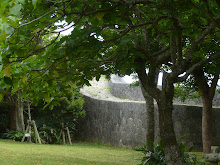
Here is an arch from the gusuku at Zakimi.
This is a UN-recognized world heritage site. The original was built during the 15th century and, after its destruction by our 20th century's warfare, the walls were reconstructed.
Zakimi was built by the stonework genius, Gosamaru. Its signature feature is the keystone in the middle of the arch.
The views from the site are spectacular. It is open to the public and is located mid-island in the village of Yomitan.
Wednesday, June 18, 2008
Stone Troughs
One of the on-land mysteries of Yonaguni is the hollowed-out stone troughs. They are knee deep, usually rectangular, about two to three feet in length. You see them everywhere, but what are they for?
I grew up watching TV cowboy shows in which Gabby Hayes always ended up dunked in the horses' watering trough, and to me, those stone containers look like tiny watering troughs for Yonaguni's tiny horses. Other guesses are: containers for a day's supply of water for household needs, vats in which to mash up grain or fruit to make wine, foot baths, and funerary urns.
With the passing of time, objects that once were in common use--things whose uses went without saying--end up as mysteries. For instance, if someone showed you one of Henry Ford's engine cranks, would you know what it was? Would you recognize a shoe button hook? How about George Washington's hair powder box?
The stone troughs scattered around Yonaguni are like that. A thousand or more years ago, no one had to ask what they were for. Is that what the future holds for I-pods?
Wednesday, May 21, 2008
Welcome to Yonaguni
Yonaguni floats in the East China Sea at 23.5 degrees North latitude, like a buoy marking the Tropic of Cancer. It is the westernmost point in Japan, and also the point farthest South. On a clear day, you can see Taiwan from Yonaguni, but you cannot see the other islands in the Okinawa chain.
The tiny and remote island Yonaguni is becoming a household word in English because of the mysterious construction submerged off its shore. Perhaps it was a pyramid, because it is composed of several layers that get progressively smaller towards the top. Perhaps it was a gusuku, the Okinawan word for a castle/fort/shrine. It may have been nothing more than an ancient quarry, or it may have been nothing at all--simply a freak of nature.
In this weblog, I will write about various aspects of the riddle of Yonaguni's submerged objet with the help of Dr. Masaaki Kimura, professor emeritus of The University of the Ryukyus and the man in charge of exploring Yonaguni's underwater mystery.
Subscribe to:
Posts (Atom)