Showing posts with label Yonaguni. Show all posts
Showing posts with label Yonaguni. Show all posts
Friday, August 8, 2014
Is This the Answer?
There was a time when the island chain that includes Okinawa was part of the east coast of China. There was another time when most of the islands in the chain were submerged, and only the highest points kept their heads above water. Since there is no evidence of crustal movement that would send an island crashing to the bottom of the sea, the most likely cause of the changes in sea level is changes to the artctic/antarctic ice caps.
It seems that another change is in the works. It is more than the simple melting of the ice. The melting of frozen strata of methane hydrate seems also to be involved. Here is news about methane hydrate from The Washington Post.
http://www.washingtonpost.com/news/morning-mix/wp/2014/08/05/scientists-may-have-cracked-the-giant-siberian-crater-mystery-and-the-news-isnt-good/?hpid=z1
(If the link doesn't work, please try copying and pasting into the browser search window)
The article is about huge craters opening in the ground in Siberia, and the theory that the craters are the result of methane morphing out of its frozen state into a powerful gas--the kind of greenhouse gas that can accelerate global warming.

Tuesday, January 24, 2012
A Tale of Two Ancient Cities
Imagine this scenario. It is almost two millennia ago. You live in a beautiful, seaside city. The surrounding land is flat and fertile. Water is abundant. As a bonus, your city sits beside a deep water harbor and enjoys the benefits of foreign trade. Your lovely city is called Bathonia.
Farther along the coast, there is another location. Water is scarce. There are steep hills overlooking another deep water harbor. Trade is possible, but the lack of water is a serious handicap. Food has to be grown elsewhere. This location came to be called Constantinople.
For some reason not fully understood, about two millennia ago, the population abandoned Bathonia and built up Constantinople. Why?
One scenario posits that Constantinople was easy to defend from the Roman legions and other attackers. This makes perfect sense. The history of the Crusades proves the defensibility of Constantinople.
But what if something else were true? Some of the ruins of Bathonia are now submerged in a lake, cut off from the Sea of Marmara. What if a devastating earthquake suddenly closed the entrance to Bathonia’s deep-sea harbor? This, too, would make perfect sense. A natural disaster devastating a hometown is a good reason to pull up stakes and rebuild elsewhere.
Studies of Bathonian ruins made accessible by a drought that lowered the water level may shed light on why Bathonia was abandoned in favor of Constantinople, now called Istanbul.
But what about Yonaguni? Where did everyone go? Why did they leave? It is so much harder to find answers when your study target is at the bottom of the sea, scoured by fast moving ocean currents.
Farther along the coast, there is another location. Water is scarce. There are steep hills overlooking another deep water harbor. Trade is possible, but the lack of water is a serious handicap. Food has to be grown elsewhere. This location came to be called Constantinople.
For some reason not fully understood, about two millennia ago, the population abandoned Bathonia and built up Constantinople. Why?
One scenario posits that Constantinople was easy to defend from the Roman legions and other attackers. This makes perfect sense. The history of the Crusades proves the defensibility of Constantinople.
But what if something else were true? Some of the ruins of Bathonia are now submerged in a lake, cut off from the Sea of Marmara. What if a devastating earthquake suddenly closed the entrance to Bathonia’s deep-sea harbor? This, too, would make perfect sense. A natural disaster devastating a hometown is a good reason to pull up stakes and rebuild elsewhere.
Studies of Bathonian ruins made accessible by a drought that lowered the water level may shed light on why Bathonia was abandoned in favor of Constantinople, now called Istanbul.
But what about Yonaguni? Where did everyone go? Why did they leave? It is so much harder to find answers when your study target is at the bottom of the sea, scoured by fast moving ocean currents.
Monday, November 7, 2011
Snake-Free!
Zamami Island, about two hours west of Naha (Okinawa) by fast ferry, is in the Kerama island group. Among the island's many charms is the fact that it does not host the deadly habu snakes found on Okinawa proper. Yonaguni is also habu-free.
The most common explanation for the fact that some islands are infested with habu and others are not goes like this. The islands that have snakes living on them were once connected. When the land bridges that connected them subsided below sea level, they became independent islands with shared animal populations. The islands that do not have snakes came into being separately, when sub-sea sedimentary rock layers were fractured, tilted, and pushed up above sea level.
The most common explanation for the fact that some islands are infested with habu and others are not goes like this. The islands that have snakes living on them were once connected. When the land bridges that connected them subsided below sea level, they became independent islands with shared animal populations. The islands that do not have snakes came into being separately, when sub-sea sedimentary rock layers were fractured, tilted, and pushed up above sea level.
Saturday, May 21, 2011
Losing a Civilization
When ten thousand lives are lost in an instant, when a way of life is wiped out in that same instant--all in one small part of the planet--you can say a civilization has been lost. That is what happened on March 11, 2011 in northeastern Japan. An earthquake coupled with a tsunami erased lives, housing, communications, transportation, and the fishing industry--the people and the way of life they created.
What's the difference between what happened in Japan's Tohoku and what happened in Yonaguni eons ago?
The simple answer is, in Tohoku, the stories were not lost. Everything was recorded in words and pictures. There were witnesses who survived.
Suppose there were witnesses who survived the Yonaguni disaster? Would the symbols and marks on stone tablets now preserved in the prefectural museum in Naha, Okinawa, be their stories?
What's the difference between what happened in Japan's Tohoku and what happened in Yonaguni eons ago?
The simple answer is, in Tohoku, the stories were not lost. Everything was recorded in words and pictures. There were witnesses who survived.
Suppose there were witnesses who survived the Yonaguni disaster? Would the symbols and marks on stone tablets now preserved in the prefectural museum in Naha, Okinawa, be their stories?
Thursday, May 20, 2010
NPO: Marine Culture Research Association AGM
The general meeting took place after the lecture at the Ryukyu Shimpo Hall in Naha, but the lecture was much more exciting than the meeting.
Another mystery!
One of the artifacts that turned up from Yonaguni and talked about at the lecture is a pillow-sized rock with a relief carving of what appears to be a water buffalo. Why a water buffalo? They are not now, nor never have been, native to the island.
A prosaic solution: Taiwan is just around the oceanic corner from Yonaguni, and there are water buffalo on Taiwan. Maybe the model for the relief carving came from Taiwan.
A more romantic solution: the model was not a real animal. What if it were modeled after the astrological Taurus?
There is a branch of archeology called archeo-astronomy. This is the study of ancient cultures that had a strong bias toward astrology, from the point of view of references to the constellations in the culture.
For instance, early Christians in the Mediterranean area used fish symbols. At the time of the birth of christianity, the spring equinox occured in the sign of the fish, Pisces. That may be a reason for the use of a fish symbol, and some archeo-astronomers believe that is the reason behind the wrath of Moses when he came down from the mountain and saw his followers worshipping a golden calf. He knew, if the ordinary people didn't, that the sun had moved on from Taurus through Aries to Pisces.
For another example, cows are sacred to the Hindu faith. Bulls are prominent in Hindu sculpture. One reason for this may be that the Hindu faith is believed to have begun some four millennia ago, when the spring equinox was in the sign of the bull, Taurus.
So. Might this water buffalo in relief be a clue to the age of Yonaguni? Or is it just a stone-age postcard from Taiwan?
Another mystery!
One of the artifacts that turned up from Yonaguni and talked about at the lecture is a pillow-sized rock with a relief carving of what appears to be a water buffalo. Why a water buffalo? They are not now, nor never have been, native to the island.
A prosaic solution: Taiwan is just around the oceanic corner from Yonaguni, and there are water buffalo on Taiwan. Maybe the model for the relief carving came from Taiwan.
A more romantic solution: the model was not a real animal. What if it were modeled after the astrological Taurus?
There is a branch of archeology called archeo-astronomy. This is the study of ancient cultures that had a strong bias toward astrology, from the point of view of references to the constellations in the culture.
For instance, early Christians in the Mediterranean area used fish symbols. At the time of the birth of christianity, the spring equinox occured in the sign of the fish, Pisces. That may be a reason for the use of a fish symbol, and some archeo-astronomers believe that is the reason behind the wrath of Moses when he came down from the mountain and saw his followers worshipping a golden calf. He knew, if the ordinary people didn't, that the sun had moved on from Taurus through Aries to Pisces.
For another example, cows are sacred to the Hindu faith. Bulls are prominent in Hindu sculpture. One reason for this may be that the Hindu faith is believed to have begun some four millennia ago, when the spring equinox was in the sign of the bull, Taurus.
So. Might this water buffalo in relief be a clue to the age of Yonaguni? Or is it just a stone-age postcard from Taiwan?
Saturday, May 8, 2010
The Gulf Methane Explosion and Yonaguni
The tragic explosion of an oil well drilling rig off the coast of New Orleans brings up a factor in the Yonaguni submerged ruins survey. The common factor is methane gas.
One possible explanation for the US disaster involves a burst of methane gas rising upward from the sea floor, expanding, and exploding. The source of the methane gas may have been a pocket of frozen methane tapped by the drilling.
A legend about Yonaguni claims that the "real" Yonaguni island disappeared ages ago in a spectacular explosion. The island is not and never has been volcanic, so there is no possibility of a Krakatoa-like exploding volcano. But the sea around Yonaguni is pocketed with deposits of frozen methane.
This is not to say that the legend about the "real" Yonaguni's disappearance is true, as legends are beyond the realm of physical proof. The US disaster is, however, living proof of the destructive power of frozen methane when it thaws and expands and comes in contact with a detonating spark.
One possible explanation for the US disaster involves a burst of methane gas rising upward from the sea floor, expanding, and exploding. The source of the methane gas may have been a pocket of frozen methane tapped by the drilling.
A legend about Yonaguni claims that the "real" Yonaguni island disappeared ages ago in a spectacular explosion. The island is not and never has been volcanic, so there is no possibility of a Krakatoa-like exploding volcano. But the sea around Yonaguni is pocketed with deposits of frozen methane.
This is not to say that the legend about the "real" Yonaguni's disappearance is true, as legends are beyond the realm of physical proof. The US disaster is, however, living proof of the destructive power of frozen methane when it thaws and expands and comes in contact with a detonating spark.
Tuesday, June 23, 2009
Annual General Meeting (2)
The 4th annual meeting of the Marine Cultural Heritage Research Association was over in a jiffy. The main news was the new camera we had to buy in order to have our underwater research broadcast on TV. How cool is that?
We now own a high-definition underwater video camera--worth it because Channel 12 (Tokyo) broadcasts our research every other month. It cost almost as much as we have--I mean had--in the treasury. It's worth it because research has to be recorded.
This past year's research focussed on the submerged ruins off Chatan, on the main island of Okinawa. Chatan is not Yonaguni, and not being Yonaguni is both the good and the bad news. People are curious about Yonaguni, so not doing more there is a letdown. On the other hand, Chatan is easy to get to and, therefore, more divers can get involved.
Getting involved is good. A diving group from the University of Tokyo has offered their assistance. A group of independent divers from Osaka has also offered theirs.
MaCHRA is alive and growing.
We now own a high-definition underwater video camera--worth it because Channel 12 (Tokyo) broadcasts our research every other month. It cost almost as much as we have--I mean had--in the treasury. It's worth it because research has to be recorded.
This past year's research focussed on the submerged ruins off Chatan, on the main island of Okinawa. Chatan is not Yonaguni, and not being Yonaguni is both the good and the bad news. People are curious about Yonaguni, so not doing more there is a letdown. On the other hand, Chatan is easy to get to and, therefore, more divers can get involved.
Getting involved is good. A diving group from the University of Tokyo has offered their assistance. A group of independent divers from Osaka has also offered theirs.
MaCHRA is alive and growing.
Wednesday, April 22, 2009
Underwater Relics--What's There?
Awesome! That's the first reaction to the submerged ruins off Yonaguni island in Okinawa. The second reaction is, why are they there? Who made them? What were they for?
As a first step towards answering all the questions their existence raises, we need to know in concrete terms what we are dealing with. That is why the work of the survey team, led by Dr. Masaaki Kimura, now professor emeritus of The University of the Ryukyus, is so important.
What, exactly, is down there, and how big is it?
Sometimes the team literally jumps in and measures things with a tape measure. Can you imagine standing still against the powerful stream of the Black Current while you hold your end of the tape against the rock being measured? Talk about awesome, it takes SCUBA skill and nerves of steel to come back with the data. The survey work began in 1992.
Systematic photographic surveys began in 1997. Again, awesome is the word.
As one of the photographers told me--a non diver--you do not roll off the boat and drop like a stone straight to the object you want to photograph. You and your equipment are at the mercy of a current that whips around the rocks like a freight train roaring downhill with the brakes off. It gets really interesting when you and the other members of the team, all carrying one essential piece of the necessary equipment, get separated. You can't exactly dial each other on the cell phone.
Now that the data fills several books and the film data would take almost a month to see in its entirety, it is easy to forget how very hard it is to acquire any data at all.
As a first step towards answering all the questions their existence raises, we need to know in concrete terms what we are dealing with. That is why the work of the survey team, led by Dr. Masaaki Kimura, now professor emeritus of The University of the Ryukyus, is so important.
What, exactly, is down there, and how big is it?
Sometimes the team literally jumps in and measures things with a tape measure. Can you imagine standing still against the powerful stream of the Black Current while you hold your end of the tape against the rock being measured? Talk about awesome, it takes SCUBA skill and nerves of steel to come back with the data. The survey work began in 1992.
Systematic photographic surveys began in 1997. Again, awesome is the word.
As one of the photographers told me--a non diver--you do not roll off the boat and drop like a stone straight to the object you want to photograph. You and your equipment are at the mercy of a current that whips around the rocks like a freight train roaring downhill with the brakes off. It gets really interesting when you and the other members of the team, all carrying one essential piece of the necessary equipment, get separated. You can't exactly dial each other on the cell phone.
Now that the data fills several books and the film data would take almost a month to see in its entirety, it is easy to forget how very hard it is to acquire any data at all.
Thursday, April 9, 2009
Marlin Fishing
Something old, something new...
Marlin fishing is considered something new in Yonaguni. The island's reputation for "big game" fishing took off after the 1930's. A thousand pound fish certainly qualifies as big. Is it that marlin didn't swim there until the 1930's or that no one noticed they were there?
The Yonaguni ruins' popularity has been soaring since the turn of the millennium. It's not that they weren't there. It's just that nobody noticed.
Marlin fishing is considered something new in Yonaguni. The island's reputation for "big game" fishing took off after the 1930's. A thousand pound fish certainly qualifies as big. Is it that marlin didn't swim there until the 1930's or that no one noticed they were there?
The Yonaguni ruins' popularity has been soaring since the turn of the millennium. It's not that they weren't there. It's just that nobody noticed.
Wednesday, July 9, 2008
2,000 km under the sea
For me, a long swim is about five successive strokes. I cannot imagine swimming 1 kilometer, let alone two thousand kilometers. Fortunately, I will never have to. If I want to travel from Guam to Okinawa, I can take a plane.A sea turtle, however, has no choice but to swim the distance.
Recently, a female green sea turtle was tracked by satellite. A transmitter was attached to one of her feet after she laid eggs on a beach in Guam. For five months, nothing was heard from the turtle. When the signal was picked up again, the turtle was grazing on seaweed near the Okinawan island of Kume. (You can see Kume Island from the airport at Naha.)
Five months is a long time between e-mails. It seems that the satellite can only pick up the signal when the turtle surfaces. Five months is also a long time to hold one's breath. It's amazing that there exists a creature who can live underwater and also on land without struggling for air.
In Okinawan mythology, the turtle is the link between worlds--the world of humans and the world of the gods. Among the relics discovered at the underwater pyramid of Yonaguni is a statue of a turtle. That stone turtle is itself a link between two worlds--our world, and the lost world of whoever carved the statue.
Who were they? Why did they carve the statue there? Where did they go when their homeland submerged? These are some of the questions to which the NPO Marine Cultural Heritage Research Association is seeking answers.
Recently, a female green sea turtle was tracked by satellite. A transmitter was attached to one of her feet after she laid eggs on a beach in Guam. For five months, nothing was heard from the turtle. When the signal was picked up again, the turtle was grazing on seaweed near the Okinawan island of Kume. (You can see Kume Island from the airport at Naha.)
Five months is a long time between e-mails. It seems that the satellite can only pick up the signal when the turtle surfaces. Five months is also a long time to hold one's breath. It's amazing that there exists a creature who can live underwater and also on land without struggling for air.
In Okinawan mythology, the turtle is the link between worlds--the world of humans and the world of the gods. Among the relics discovered at the underwater pyramid of Yonaguni is a statue of a turtle. That stone turtle is itself a link between two worlds--our world, and the lost world of whoever carved the statue.
Who were they? Why did they carve the statue there? Where did they go when their homeland submerged? These are some of the questions to which the NPO Marine Cultural Heritage Research Association is seeking answers.
Wednesday, June 18, 2008
Stone Troughs
One of the on-land mysteries of Yonaguni is the hollowed-out stone troughs. They are knee deep, usually rectangular, about two to three feet in length. You see them everywhere, but what are they for?
I grew up watching TV cowboy shows in which Gabby Hayes always ended up dunked in the horses' watering trough, and to me, those stone containers look like tiny watering troughs for Yonaguni's tiny horses. Other guesses are: containers for a day's supply of water for household needs, vats in which to mash up grain or fruit to make wine, foot baths, and funerary urns.
With the passing of time, objects that once were in common use--things whose uses went without saying--end up as mysteries. For instance, if someone showed you one of Henry Ford's engine cranks, would you know what it was? Would you recognize a shoe button hook? How about George Washington's hair powder box?
The stone troughs scattered around Yonaguni are like that. A thousand or more years ago, no one had to ask what they were for. Is that what the future holds for I-pods?
I grew up watching TV cowboy shows in which Gabby Hayes always ended up dunked in the horses' watering trough, and to me, those stone containers look like tiny watering troughs for Yonaguni's tiny horses. Other guesses are: containers for a day's supply of water for household needs, vats in which to mash up grain or fruit to make wine, foot baths, and funerary urns.
With the passing of time, objects that once were in common use--things whose uses went without saying--end up as mysteries. For instance, if someone showed you one of Henry Ford's engine cranks, would you know what it was? Would you recognize a shoe button hook? How about George Washington's hair powder box?
The stone troughs scattered around Yonaguni are like that. A thousand or more years ago, no one had to ask what they were for. Is that what the future holds for I-pods?
Saturday, June 14, 2008
World of Stones
The underwater ruins at Yonaguni's Iseki Point meet the powerful Black Current head on. If they have been there for any length of time, anything light or portable will have washed away. It goes without saying that anything that could be dissolved in water or eaten away by marine life would also be gone. Only stone remains.
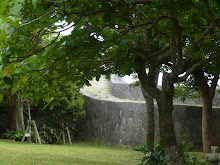
A typical feature of the ancient castle/fort/shrine structures known as gusuku in Okinawa is a surrounding wall made of piled up rocks and a stone-paved road. (see the photo from Shuri Castle in Naha) Underwater surveys of Iseki Point show a loop road with a retaining wall made of boulders held in place with smaller rocks.
The loop road and wall are good reasons to believe that Iseki Point was once part of a gusuku complex.
A typical feature of the ancient castle/fort/shrine structures known as gusuku in Okinawa is a surrounding wall made of piled up rocks and a stone-paved road. (see the photo from Shuri Castle in Naha) Underwater surveys of Iseki Point show a loop road with a retaining wall made of boulders held in place with smaller rocks.
The loop road and wall are good reasons to believe that Iseki Point was once part of a gusuku complex.
Monday, June 9, 2008
Yonaguni NPO Annual General Meeting
June 7 was the big day. Membership is up. Sponsorship is up. What's more, media interest in Yonaguni is still strong. One of the attractions at the meeting was a screening of Discovery Channel's program on unsolved mysteries which featured Yonaguni's Iseki Point along with a site off Great Britain's Isle of Wight and another submerged site along the Indian coast.
Dr. Masaaki Kimura, chairman of the NPO Marine Cultural Heritage Research Association, is fond of quoting his favorite professor's advice to look for traces of the world's most ancient civilizations under water. The world's coastlines have changed drastically over the eons, and what used to be prime real estate is now submerged. He heard that advice some 40 years ago, and chose to act on it. It was interesting that the Discovery Channel program ended with the comment that future discoveries concerning mankind's past will not be made on land; they will be made at the bottom of the sea.
That means the relics at Yonaguni are part of the world's cultural heritage. If they are as old as many experts suspect--dating from 10,000 years ago--Iseki Point may be where the world's oldest building stands.
Dr. Masaaki Kimura, chairman of the NPO Marine Cultural Heritage Research Association, is fond of quoting his favorite professor's advice to look for traces of the world's most ancient civilizations under water. The world's coastlines have changed drastically over the eons, and what used to be prime real estate is now submerged. He heard that advice some 40 years ago, and chose to act on it. It was interesting that the Discovery Channel program ended with the comment that future discoveries concerning mankind's past will not be made on land; they will be made at the bottom of the sea.
That means the relics at Yonaguni are part of the world's cultural heritage. If they are as old as many experts suspect--dating from 10,000 years ago--Iseki Point may be where the world's oldest building stands.
Monday, May 26, 2008
Homemade Submarine
The submerged ruins at Yonaguni cover so much area that a diver cannot take in the entire panorama in a single view. A scuba diver has a little more than half an hour to see what he can, but a snorkeler or skin diver has only a minute or so.
One skin diver who made many dives at Yonaguni's Iseki Point was the man with the world's breath holding record, Jacques Mayol. He came up with a unique way to get a feel for the immense scope of the ruins in a single dive.
Jacques didn't like to be encumbered with scuba gear. On the other hand, he also acknowledged that even he--the dolphin man of the diving world--had limits to how long he could stay underwater without breathing. So what he did was design a board that he could hang on to and also steer up and down as he sped past the ruins at the end of a rope towed by a motorboat. He called the board his "bargain submarine". No windows, no seats, no periscope. Just a high-performance fin.
Because Yonaguni, as the first island to stand in its way, takes the brunt of the ferocious Black Current, even scuba divers have a hard time getting where they want to go at Iseki Point. So Jacques' feat was awesome in the extreme.
Between the violent current, the huge scale of the ruins, and the hammerhead sharks, I think I will wait until someone institutes tours by glass bottom boat.
One skin diver who made many dives at Yonaguni's Iseki Point was the man with the world's breath holding record, Jacques Mayol. He came up with a unique way to get a feel for the immense scope of the ruins in a single dive.
Jacques didn't like to be encumbered with scuba gear. On the other hand, he also acknowledged that even he--the dolphin man of the diving world--had limits to how long he could stay underwater without breathing. So what he did was design a board that he could hang on to and also steer up and down as he sped past the ruins at the end of a rope towed by a motorboat. He called the board his "bargain submarine". No windows, no seats, no periscope. Just a high-performance fin.
Because Yonaguni, as the first island to stand in its way, takes the brunt of the ferocious Black Current, even scuba divers have a hard time getting where they want to go at Iseki Point. So Jacques' feat was awesome in the extreme.
Between the violent current, the huge scale of the ruins, and the hammerhead sharks, I think I will wait until someone institutes tours by glass bottom boat.
Wednesday, May 21, 2008
Welcome to Yonaguni
Yonaguni floats in the East China Sea at 23.5 degrees North latitude, like a buoy marking the Tropic of Cancer. It is the westernmost point in Japan, and also the point farthest South. On a clear day, you can see Taiwan from Yonaguni, but you cannot see the other islands in the Okinawa chain.
The tiny and remote island Yonaguni is becoming a household word in English because of the mysterious construction submerged off its shore. Perhaps it was a pyramid, because it is composed of several layers that get progressively smaller towards the top. Perhaps it was a gusuku, the Okinawan word for a castle/fort/shrine. It may have been nothing more than an ancient quarry, or it may have been nothing at all--simply a freak of nature.
In this weblog, I will write about various aspects of the riddle of Yonaguni's submerged objet with the help of Dr. Masaaki Kimura, professor emeritus of The University of the Ryukyus and the man in charge of exploring Yonaguni's underwater mystery.
The tiny and remote island Yonaguni is becoming a household word in English because of the mysterious construction submerged off its shore. Perhaps it was a pyramid, because it is composed of several layers that get progressively smaller towards the top. Perhaps it was a gusuku, the Okinawan word for a castle/fort/shrine. It may have been nothing more than an ancient quarry, or it may have been nothing at all--simply a freak of nature.
In this weblog, I will write about various aspects of the riddle of Yonaguni's submerged objet with the help of Dr. Masaaki Kimura, professor emeritus of The University of the Ryukyus and the man in charge of exploring Yonaguni's underwater mystery.
Subscribe to:
Posts (Atom)