Something old, something new...
Marlin fishing is considered something new in Yonaguni. The island's reputation for "big game" fishing took off after the 1930's. A thousand pound fish certainly qualifies as big. Is it that marlin didn't swim there until the 1930's or that no one noticed they were there?
The Yonaguni ruins' popularity has been soaring since the turn of the millennium. It's not that they weren't there. It's just that nobody noticed.
Thursday, April 9, 2009

Saturday, April 4, 2009

Wednesday, July 9, 2008
2,000 km under the sea
For me, a long swim is about five successive strokes. I cannot imagine swimming 1 kilometer, let alone two thousand kilometers. Fortunately, I will never have to. If I want to travel from Guam to Okinawa, I can take a plane.A sea turtle, however, has no choice but to swim the distance.
Recently, a female green sea turtle was tracked by satellite. A transmitter was attached to one of her feet after she laid eggs on a beach in Guam. For five months, nothing was heard from the turtle. When the signal was picked up again, the turtle was grazing on seaweed near the Okinawan island of Kume. (You can see Kume Island from the airport at Naha.)
Five months is a long time between e-mails. It seems that the satellite can only pick up the signal when the turtle surfaces. Five months is also a long time to hold one's breath. It's amazing that there exists a creature who can live underwater and also on land without struggling for air.
In Okinawan mythology, the turtle is the link between worlds--the world of humans and the world of the gods. Among the relics discovered at the underwater pyramid of Yonaguni is a statue of a turtle. That stone turtle is itself a link between two worlds--our world, and the lost world of whoever carved the statue.
Who were they? Why did they carve the statue there? Where did they go when their homeland submerged? These are some of the questions to which the NPO Marine Cultural Heritage Research Association is seeking answers.
Saturday, July 5, 2008
Speaking of Stone ...

Here is an arch from the gusuku at Zakimi.
This is a UN-recognized world heritage site. The original was built during the 15th century and, after its destruction by our 20th century's warfare, the walls were reconstructed.
Zakimi was built by the stonework genius, Gosamaru. Its signature feature is the keystone in the middle of the arch.
The views from the site are spectacular. It is open to the public and is located mid-island in the village of Yomitan.
Wednesday, June 18, 2008
Stone Troughs
One of the on-land mysteries of Yonaguni is the hollowed-out stone troughs. They are knee deep, usually rectangular, about two to three feet in length. You see them everywhere, but what are they for?
I grew up watching TV cowboy shows in which Gabby Hayes always ended up dunked in the horses' watering trough, and to me, those stone containers look like tiny watering troughs for Yonaguni's tiny horses. Other guesses are: containers for a day's supply of water for household needs, vats in which to mash up grain or fruit to make wine, foot baths, and funerary urns.
With the passing of time, objects that once were in common use--things whose uses went without saying--end up as mysteries. For instance, if someone showed you one of Henry Ford's engine cranks, would you know what it was? Would you recognize a shoe button hook? How about George Washington's hair powder box?
The stone troughs scattered around Yonaguni are like that. A thousand or more years ago, no one had to ask what they were for. Is that what the future holds for I-pods?
Saturday, June 14, 2008
World of Stones
The underwater ruins at Yonaguni's Iseki Point meet the powerful Black Current head on. If they have been there for any length of time, anything light or portable will have washed away. It goes without saying that anything that could be dissolved in water or eaten away by marine life would also be gone. Only stone remains.
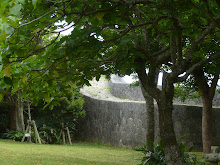
A typical feature of the ancient castle/fort/shrine structures known as gusuku in Okinawa is a surrounding wall made of piled up rocks and a stone-paved road. (see the photo from Shuri Castle in Naha) Underwater surveys of Iseki Point show a loop road with a retaining wall made of boulders held in place with smaller rocks.
The loop road and wall are good reasons to believe that Iseki Point was once part of a gusuku complex.
Monday, June 9, 2008
Yonaguni NPO Annual General Meeting
June 7 was the big day. Membership is up. Sponsorship is up. What's more, media interest in Yonaguni is still strong. One of the attractions at the meeting was a screening of Discovery Channel's program on unsolved mysteries which featured Yonaguni's Iseki Point along with a site off Great Britain's Isle of Wight and another submerged site along the Indian coast.
Dr. Masaaki Kimura, chairman of the NPO Marine Cultural Heritage Research Association, is fond of quoting his favorite professor's advice to look for traces of the world's most ancient civilizations under water. The world's coastlines have changed drastically over the eons, and what used to be prime real estate is now submerged. He heard that advice some 40 years ago, and chose to act on it. It was interesting that the Discovery Channel program ended with the comment that future discoveries concerning mankind's past will not be made on land; they will be made at the bottom of the sea.
That means the relics at Yonaguni are part of the world's cultural heritage. If they are as old as many experts suspect--dating from 10,000 years ago--Iseki Point may be where the world's oldest building stands.
Subscribe to:
Posts (Atom)