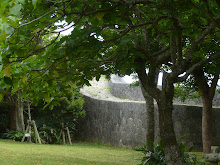
So much about geology is speculation about what might have happened in the misty, distant past. That's why the story about the glacier melting in Alaska at this very moment is so fascinating.
What happens when a glacier melts? Where does the water go? Obviously, it goes into the ocean, but then what? Does the ocean get deeper?
That's hard to measure, but in Alaska, the one thing that is easy to measure is that the land--not sea level--is what's rising.
(link to NY Times http://www.nytimes.com/2009/05/18/science/earth/18juneau.html?hp)
What used to be a salmon stream is now a grassy path. What used to be a golf course with a driving range that flooded at high tide is now getting new links. This is all happening now and over the past fifty years.
Fifty years is plenty of time for people to react to their new geographic reality. But what about Yonaguni? When it went the other way--when it submerged--did it happen slowly enough for people to react? Or was it a sudden, disastrous geologic event.
No one knows. Yet.
Sunday, May 17, 2009

Monday, April 27, 2009
Time Out
It's Golden Week in Japan--a holiday studded spring break.
Yonaguni Tales will be continued after Golden Week.
Yonaguni Tales will be continued after Golden Week.
Wednesday, April 22, 2009
Underwater Relics--What's There?
Awesome! That's the first reaction to the submerged ruins off Yonaguni island in Okinawa. The second reaction is, why are they there? Who made them? What were they for?
As a first step towards answering all the questions their existence raises, we need to know in concrete terms what we are dealing with. That is why the work of the survey team, led by Dr. Masaaki Kimura, now professor emeritus of The University of the Ryukyus, is so important.
What, exactly, is down there, and how big is it?
Sometimes the team literally jumps in and measures things with a tape measure. Can you imagine standing still against the powerful stream of the Black Current while you hold your end of the tape against the rock being measured? Talk about awesome, it takes SCUBA skill and nerves of steel to come back with the data. The survey work began in 1992.
Systematic photographic surveys began in 1997. Again, awesome is the word.
As one of the photographers told me--a non diver--you do not roll off the boat and drop like a stone straight to the object you want to photograph. You and your equipment are at the mercy of a current that whips around the rocks like a freight train roaring downhill with the brakes off. It gets really interesting when you and the other members of the team, all carrying one essential piece of the necessary equipment, get separated. You can't exactly dial each other on the cell phone.
Now that the data fills several books and the film data would take almost a month to see in its entirety, it is easy to forget how very hard it is to acquire any data at all.
Thursday, April 9, 2009
Marlin Fishing
Something old, something new...
Marlin fishing is considered something new in Yonaguni. The island's reputation for "big game" fishing took off after the 1930's. A thousand pound fish certainly qualifies as big. Is it that marlin didn't swim there until the 1930's or that no one noticed they were there?
The Yonaguni ruins' popularity has been soaring since the turn of the millennium. It's not that they weren't there. It's just that nobody noticed.
Saturday, April 4, 2009

Wednesday, July 9, 2008
2,000 km under the sea
For me, a long swim is about five successive strokes. I cannot imagine swimming 1 kilometer, let alone two thousand kilometers. Fortunately, I will never have to. If I want to travel from Guam to Okinawa, I can take a plane.A sea turtle, however, has no choice but to swim the distance.
Recently, a female green sea turtle was tracked by satellite. A transmitter was attached to one of her feet after she laid eggs on a beach in Guam. For five months, nothing was heard from the turtle. When the signal was picked up again, the turtle was grazing on seaweed near the Okinawan island of Kume. (You can see Kume Island from the airport at Naha.)
Five months is a long time between e-mails. It seems that the satellite can only pick up the signal when the turtle surfaces. Five months is also a long time to hold one's breath. It's amazing that there exists a creature who can live underwater and also on land without struggling for air.
In Okinawan mythology, the turtle is the link between worlds--the world of humans and the world of the gods. Among the relics discovered at the underwater pyramid of Yonaguni is a statue of a turtle. That stone turtle is itself a link between two worlds--our world, and the lost world of whoever carved the statue.
Who were they? Why did they carve the statue there? Where did they go when their homeland submerged? These are some of the questions to which the NPO Marine Cultural Heritage Research Association is seeking answers.
Saturday, July 5, 2008
Speaking of Stone ...

Here is an arch from the gusuku at Zakimi.
This is a UN-recognized world heritage site. The original was built during the 15th century and, after its destruction by our 20th century's warfare, the walls were reconstructed.
Zakimi was built by the stonework genius, Gosamaru. Its signature feature is the keystone in the middle of the arch.
The views from the site are spectacular. It is open to the public and is located mid-island in the village of Yomitan.
Subscribe to:
Posts (Atom)